01The system behind the project
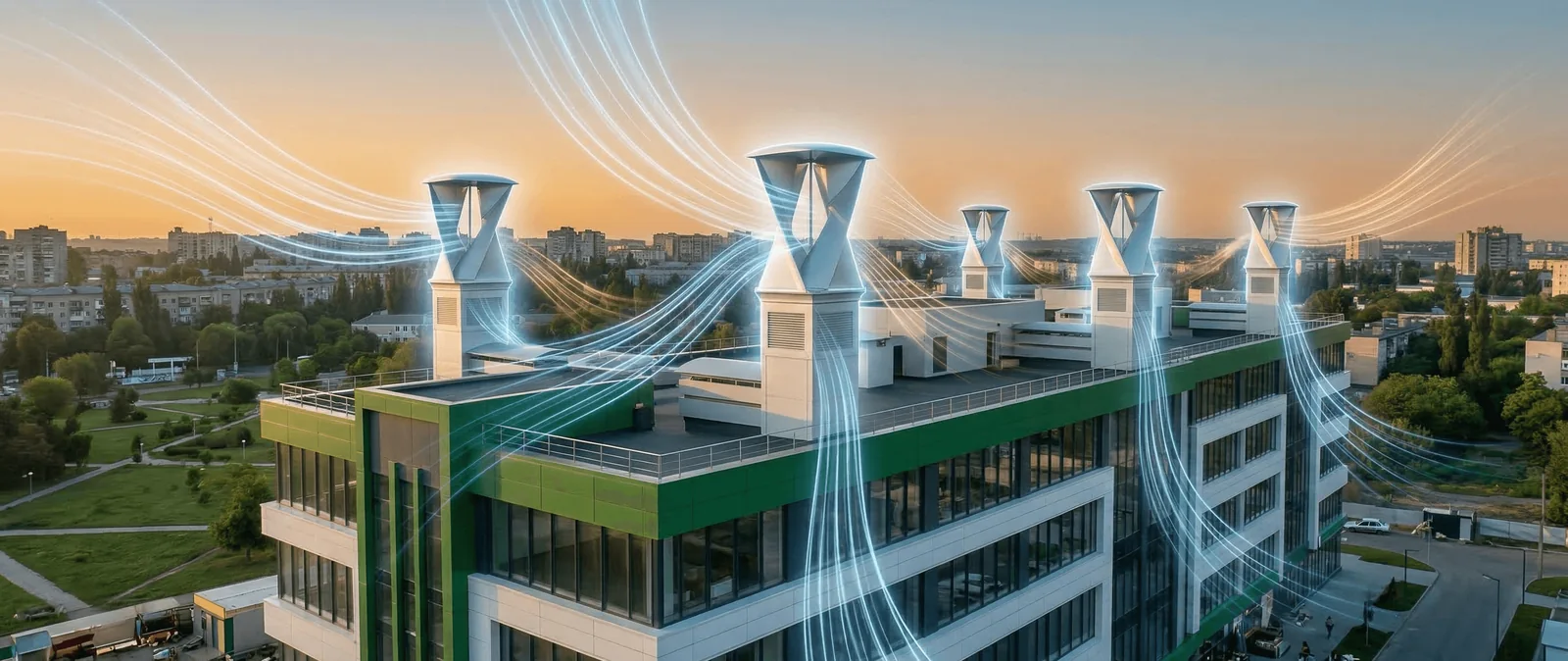
CatchWind is a prototype passive windcatcher intended to support natural airflow in buildings without fan electricity. Its value proposition is lower-energy and outage-resilient ventilation where wind, building geometry and occupancy make the approach suitable. The source indicates a prototype, digital and financial models, planned testing, certification and production preparation; it does not establish certified performance or serial manufacture. Functionally, schools, healthcare facilities, homes and commercial buildings across the agglomeration could form a repeatable market, but no intermunicipal procurement or installed portfolio is evidenced.
02How the intervention works
The product must operate as part of the building envelope and ventilation strategy, not as an isolated rooftop object. Engineering should cover wind capture, transfer ducts, controlled distribution and exhaust, rain and snow protection, condensate drainage, insects, acoustics, fire compartmentation, cleaning access and structural loads. Adjustable dampers and simple monitoring can show when natural driving pressure is adequate and when a hybrid backup is needed. Performance must be mapped to wind direction and speed, internal resistance, room demand and outdoor air quality, with configurations defined for new construction and retrofit.
03From concept to an operable asset
Delivery should progress from computational and wind-tunnel evaluation to full-scale prototypes tested under varied wind, temperature and occupancy conditions. Measured airflow, pressure, noise, weather resistance and indoor-air outcomes should set design revisions. Building-code, hygiene, fire and structural evidence then supports certification and design-for-manufacture. Limited pilots in different building types should include baseline comparison, seasonal monitoring, maintenance observation and user feedback before production-line investment. The source price and programme budget are proposal data; they do not demonstrate achieved unit cost, customer orders, certification, completed pilots or manufacturing readiness.
04What must be proven before commitment
Product due diligence must review raw test data, calibration of instruments, representativeness of climatic conditions, airflow performance across wind directions, acoustic and thermal effects, rain ingress, fire behaviour, structural loading and maintainability. Claims about energy or emissions savings require a clear mechanical-ventilation baseline and measured operating periods. Reviewers should also examine certification pathway, product liability, intellectual-property ownership, freedom to operate, manufacturing tolerances, warranty, installation training and after-sales support. The stated source price needs validated bill of materials, labour, distribution, installation and lifecycle cost before commercial commitment.
05Where a partner can create value
The project needs building physicists and ventilation engineers, aerodynamic and wind-tunnel laboratories, structural and fire engineers, and certification bodies familiar with ventilation products and envelope components. Architects, roof and façade specialists, installers and facility operators should co-design interfaces and safe maintenance access. Pilot hosts must represent different building types and permit independent seasonal monitoring. Manufacturing partners require capability in repeatable sheet-metal or composite fabrication, seals, dampers, quality control and traceability. Controls specialists can integrate simple sensing and hybrid backup logic, while commercial partners must support installer training, warranties and documented performance rather than unsupported savings claims.