01The system behind the project
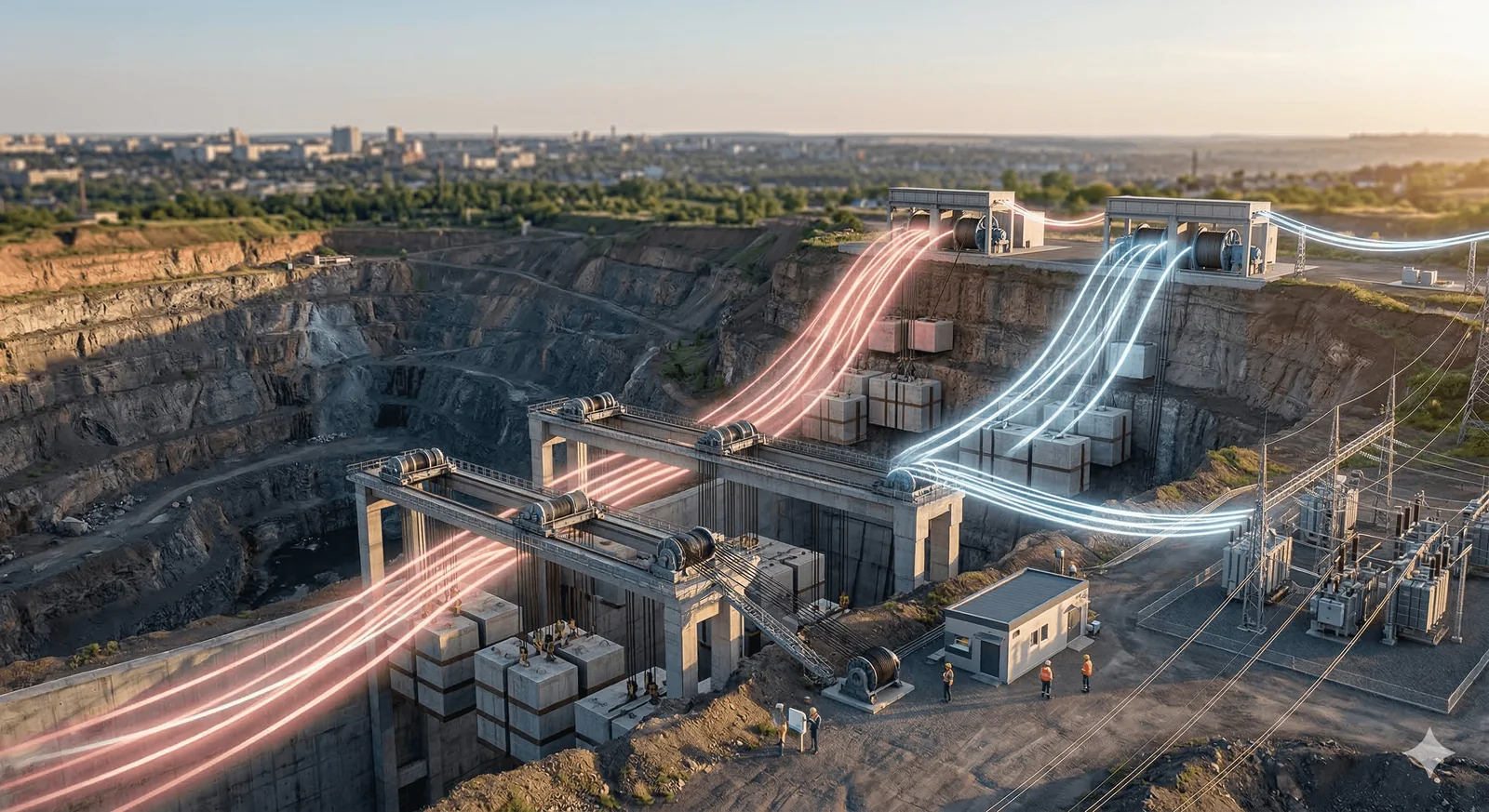
Gravic-Acc is an early concept for storing electricity by lifting and lowering masses in disused quarries; site selection, geotechnical feasibility, capacity, efficiency, safety, permitting and economics still require independent validation. The grid needs flexible storage while former quarries need viable reuse. The concept matches the agglomeration’s mining landscape, but no quarry, owner, grid connection or intermunicipal arrangement is yet confirmed. The concept is a site-dependent storage hypothesis, not an automatic consequence of having former quarries. Functional relevance to the mining agglomeration depends on a selected void, lawful control, suitable rock and geometry, a credible grid node and a safe operating perimeter.
02How the intervention works
Gravic-Acc needs a site-specific system model joining quarry geometry, rock behaviour, hoisting equipment, electrical conversion, storage controls and the grid interface. A site model must couple three-dimensional quarry geometry, rock-mass classification, slopes and groundwater with the moving mass, guides, hoisting machinery, foundations, braking and containment. Electrical design covers motor-generators, converters, transformer, connection and dispatch controls. Instrumentation must monitor position, load, vibration, deformation, water and exclusion zones, with fail-safe arrest and recovery modes. No capacity, efficiency, schedule or economic result should be published for a site until the underlying geometry, duty cycle and grid assumptions are traceable.
03From concept to an operable asset
Begin with a quarry screening register and disqualifying criteria, then secure access for mapping, drilling, hydrogeology and grid studies. A calibrated geotechnical model and concept design should establish feasible travel, mass, cycle, power and energy before a physical demonstrator. Prototype tests must validate braking, fatigue, controls and round-trip efficiency. Bankable design follows only after independent safety review and connection evidence. The source identifies an early concept with no selected site; it does not evidence land control, grid connection, permits, construction or operating revenue.
04What must be proven before commitment
Due diligence for Gravic-Acc must verify quarry ownership, mining closure obligations, slope stability, subsidence, groundwater, geohazards, access and future land-use constraints. It must reproduce power, duration, efficiency, cycle life, auxiliary demand and degradation calculations; confirm grid studies and dispatch value; and test capital cost, maintenance, insurance, safety case, permitting, constructionability, decommissioning and revenue stacking under conservative utilisation. Approval requires an independent safety case covering dropped load, overspeed, structural failure, slope movement, water ingress and rescue access.
05Where a partner can create value
The project requires mining geologists, rock-mechanics and hydrogeology teams, quarry surveyors, heavy-hoist and structural engineers, motor-generator and power-electronics integrators, grid modellers, machinery-safety and functional-safety assessors, emergency planners, insurers and storage financiers. The quarry owner and network operator must provide verifiable constraints. Independent laboratories should test materials, brakes and fatigue; an owner's engineer should control interfaces and evidence. The owner's engineer should integrate geotechnics, hoisting and power systems and hold the interface register independently from equipment vendors.